



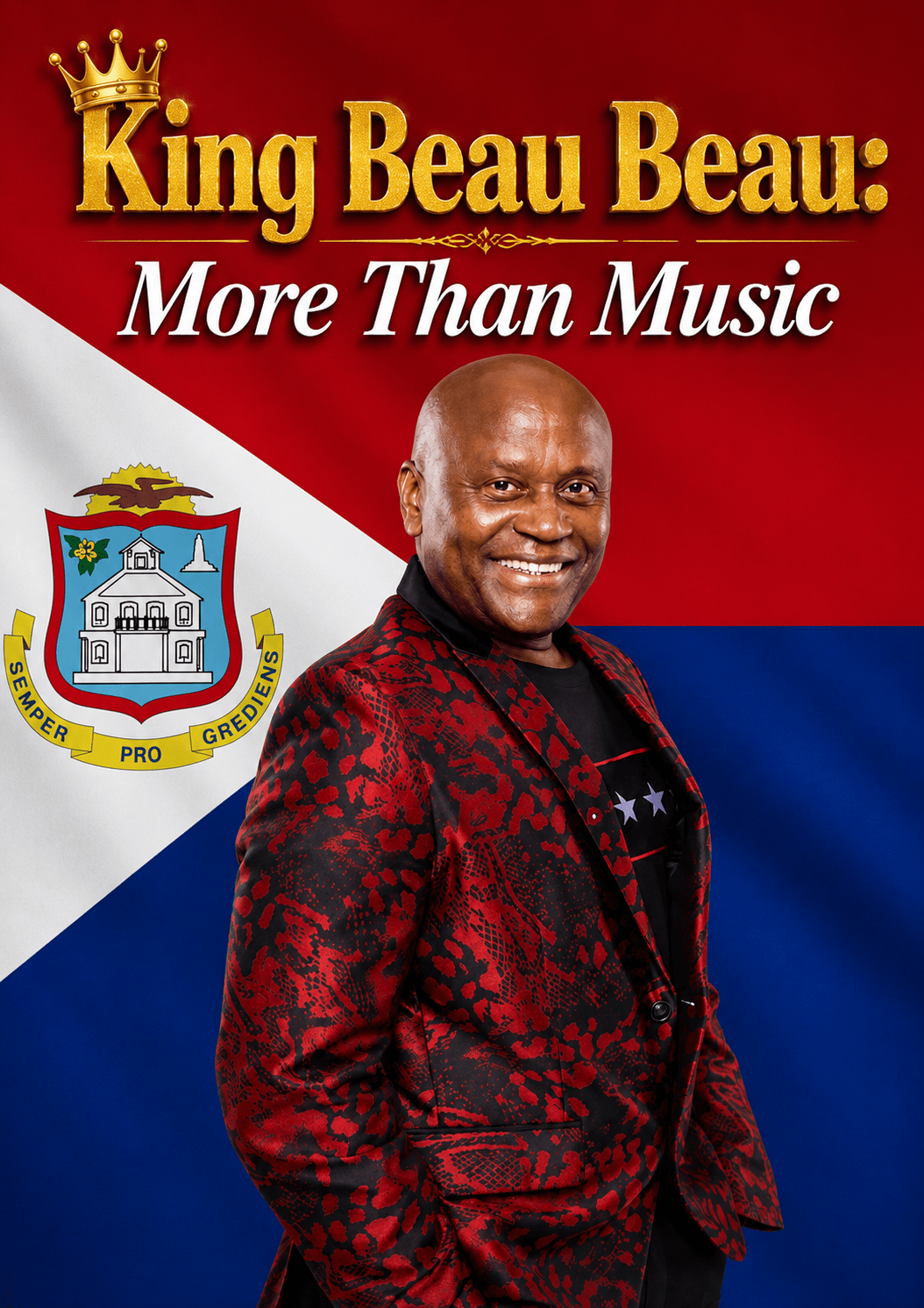
King Beau Beau: More Than Music
For nearly five decades, Leroy Lucien Brooks — better known as King Beau Beau — has been a familiar and influential voice in St. Maarten’s calypso and entertainment scene.A 12-time St. Maarten Calypso Monarch, songwriter, musician, performer and cultural representative, Beau Beau has taken his music far beyond the island. His career has included performances throughout the Caribbean, the United States, Canada and Europe, including appearances at the Apollo Theatre in New York and at the opening of Speed 2 in Los Angeles with his Beaubettes. But his story is about more than music.
His work reflects the history, personality and experiences of St. Maarten and the wider Caribbean. Through calypso, he has used real-life experiences, social and political circumstances and current events as inspiration for his songs. His career also demonstrates how a St. Maarten artist can use music as a way of representing his island and connecting it with audiences around the world.
King Beau Beau’s achievements.
Beau Beau’s competition record is substantial. He has been crowned St. Maarten Calypso Monarch 12 times, making him the island’s Calypso King with the most wins.
His titles include:
• 12-time St. Maarten Calypso Monarch: 1980, 1981, 1984, 1985, 1988, 1989, 1990, 2000, 2008, 2009, 2010 and 2022
• 2-time Road March King: 1980 and 1981
• 3-time Antillean Calypso Monarch: 1980, 1981 and 1982
• Leeward Islands Calypso Monarch: 2000
• King of Kings Monarch: 2009
• Golden Voice Song Festival Winner: 1976, at age 16
The Interview
CV: How did you come up with your very unique calypso name?
KBB: I got my unique name from a school play that I took part in. This was way back in secondary school in 1976, prior to singing calypso. In this comedy play I had the lead role where my name was Bobo. I started singing calypso in 1978 where the name Bobo just stuck. Later on, I was told that the word Bobo meant stupid. Not being able to get rid of the name I changed the spelling in the mid-1980s to Beau Beau. So, it sounded the same but was spelled different. ‘Beau Beau’ translated from French to English literally means very handsome, lol.”
The story of the name actually goes back to a school production directed by my teacher, Josianne Artsen/Fleming. I played the lead character in the comedy Big Business, and the audience enjoyed the production so much that the name Bobo followed me long after the play ended.
Rather than abandoning the name, I reinvented it.
CV. What is your real name?
KBB: My real name is Leroy Lucien Brooks.
CV: Where were you born?
KBB: I was born in St. Maarten at home in Downstreet, Philipsburg.”
Born on November 5, 1959, I am the eighth of ten children — nine boys and one girl — and I’m the first of my siblings to be born on St. Maarten. My older siblings were born in Curaçao.
CV: How were you introduced to calypso?
KBB: I fell in love with calypso from since I was about 6 years old listening to PJD2 radio right here in St. Maarten.
Music was part of my life from childhood. My mother would later proudly say that I could sing before I learned to talk and dance before I learned to walk.
My early exposure to performance came through school, radio and my music teacher. As a child, I also sang a cappella on PJD2 Radio’s Big Brother & Big Sister Show, hosted by Dave Douglas and Josianne Artsen.
CV: Who inspired you in the artform?
KBB: My idol has always been the Mighty Sparrow. His rhythm, his music, his lyrics, his voice and his energy just captivated my soul from within.”
The influence of calypso’s storytelling tradition can be seen in my own approach to songwriting. I draw inspiration from what is happening around me rather than limiting my music to one subject or theme.
CV: Do you play any instruments or does anyone in your family?
KBB: In my younger years I played the drums and dabbled with the guitar. In my later years I switched over to the keyboards, but this was more to assist me in creating, writing and arranging my music.
My formal education also contributed to my development as an artist. After Milton Peters College, I received three scholarships and attended Hofstra University in New York from 1980 to 1984, where I majored in Music Merchandising and minored in Communications.
CV: When did you first enter the calypso arena?
KBB: My first attempt at the calypso crown was in 1978. I was not successful. I believe I came in last out of 10 contestants. Lol.
That first attempt was the beginning of what would become one of the most successful calypso careers in St. Maarten. My first St. Maarten Calypso Monarch victory came in 1980 with “Case from Hell.”
CV. How many years have you been singing calypso?
KBB: have been singing calypso (on and off) for approximately 48 years.”
CV. Did you sing in the Junior Calypso Competition also?
KBB:Unfortunately, no. In my younger years the Junior Calypso Competition did not yet exist. That was introduced here many years later.
A Career Beyond Calypso
Although calypso remains at the heart of his work, Beau Beau’s repertoire is broader. For international performances, he has also performed soca, reggae, ballads, kompa and pop.
He has written approximately 180 songs and has more than 25 recordings. His career has taken him across the Caribbean and to the United States, Canada, Europe and other parts of the world. While studying at Hofstra University, he would travel on weekends to perform, sometimes returning to the Caribbean and travelling onward to other international destinations.
He also travelled extensively with his Beaubettes, representing St. Maarten/Saint Martin at events in the United States and Canada through the St. Maarten/Saint Martin Association, in collaboration with the Dutch and French St. Martin tourism offices.
Among his most memorable performances are appearing on stage in St. Maarten with the late Percy Sledge, performing with his Beaubettes at the opening of Speed 2 in Los Angeles, and performing at the Apollo Theatre in New York.
For a St. Maarten artist, those international stages represent more than personal achievement. They also provided opportunities to bring the island’s music, identity and personality to audiences outside the Caribbean.
That places his work firmly within one of calypso’s longstanding traditions: using music to comment on society. He also considers himself an old-school artist.
“I love to write/sing songs that are musically well arranged with an array of melody,” he says. He believes Caribbean music, particularly calypso and soca, has moved away from some of the musical elements he values, including strong arrangements, melody and meaningful lyrics.
For Beau Beau, the music itself matters. That’s why years later, “The Stick” popularly known for the hook “You think you can wuk up more than me?” can still make young and old dance 37 years after it was selected as the Road March song in 1989.