

We Survived the Pandemic. But Did We Ever Really Heal?
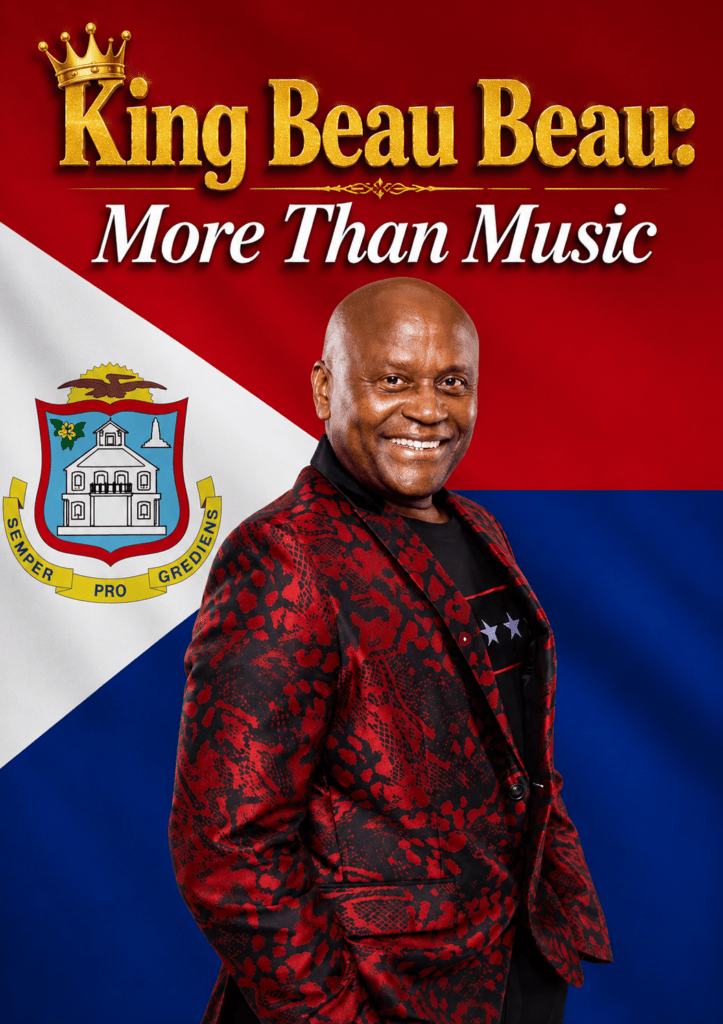
CLICK POSTER TO VIEW VIDEO
We learned to wear masks during the pandemic, kept our distance, washed our hands and waited for the world to reopen. We watched the news for updates, worried about loved ones, attended funerals when we could, and tried to make sense of a future that changed overnight.
Businesses closed. Flights were cancelled. Schools shut their doors. People lost loved ones, jobs, savings and the routines that had once made life comfortable and predictable.
Eventually, restrictions eased and the world officially reopened in 2023; in 2022 travel bans and masks were stopped but it wasn’t officially stated. Airports reopened. Tourists returned to Caribbean shores. Offices and schools filled again. Governments spoke about recovery, economies began to rebuild, and the world moved forward. We shouted, “Outside again!” and danced and pranced to the songs with that hook as music became the drug to navigate us out of our stupor.
But did everyone recover?
For some people, the hardest part did not end when the lockdowns ended. It continued in unpaid bills, depleted savings, strained relationships, disrupted education, grief, anxiety and the quiet fear that another crisis could take everything away.
On 10 October 2026, World Mental Health Day, the world was invited by the World Health Organisation to reflect on a message that speaks directly to this unfinished recovery: “Lived Experiences Heard: Real Voices, Real Change.” The World Health Organization (WHO) is calling for people who have experienced mental health challenges to help shape the policies, services and decisions that affect their lives—not simply to tell their stories and then be left out of the decisions that follow.
For Caribbean Vybes, this is an opportunity to ask a question that reaches beyond the anniversary of a global health emergency: have we made enough room for people to speak honestly about what the pandemic took from them—and what they still need?
The world changed—and mental health paid a price
COVID-19 was not only a physical health emergency. It became an economic, social and emotional crisis.
In March 2022, the WHO reported that the global prevalence of anxiety and depression had increased by approximately 25% during the first year of the pandemic. The organisation identified several contributing pressures, including isolation, bereavement, fear of infection, financial worries and restrictions on people’s ability to work or connect with loved ones. What about the discrimination, the unvaccinated faced?
The WHO’s Director-General, Dr Tedros Adhanom Ghebreyesus, described the findings as a “wake-up call” for countries to pay greater attention to mental health and improve support for their populations.
The figures are not proof that every person who experienced hardship developed a mental health condition. They do, however, show the scale of the psychological strain experienced around the world.
Read the WHO report: COVID-19 pandemic triggers 25% increase in anxiety and depression worldwide.
The reasons were understandable. People were afraid of becoming ill or losing someone they loved. Health workers faced exhausting shifts and difficult decisions. Parents tried to manage work and childcare while schools were closed. Young people lost opportunities to socialise, learn and experience important milestones. Others endured loneliness, domestic tensions or the distress of being separated from family.
Then there was the financial uncertainty.
For a person who had lost a job, the fear of the virus was accompanied by a second fear: How will I pay the rent? How will I feed my children? What happens when the assistance runs out?
For someone running a small business, it meant watching years of work disappear in a matter of weeks.
And for people who lost loved ones, the pain was made more complicated by restrictions that prevented them from saying goodbye in the ways they needed.
In May 2020, United Nations Secretary-General António Guterres warned that mental health needed to be an essential part of governments’ COVID-19 responses. He specifically identified grief, job losses, isolation, difficult family dynamics and uncertainty about the future as sources of psychological suffering. He also cautioned that these effects would continue even after the pandemic came under control.
His message was important because it recognised something that can be overlooked when societies measure recovery mainly through economic growth: a crisis can end on a public calendar without ending in a person’s life.
Read the United Nations Secretary-General’s statement on mental health and COVID-19
The Caribbean: when tourism stopped, so did many livelihoods
The pandemic struck Caribbean economies in a particularly difficult place: their dependence on travel, tourism and the businesses connected to visitors.
Tourism is not simply about hotels and beaches. It supports taxi drivers, tour operators, restaurant workers, vendors, musicians, entertainers, shopkeepers, boat operators, farmers, fishermen, cleaners, maintenance workers and countless small businesses. It also supports families whose incomes depend on people travelling, spending and enjoying what the region offers.
When international travel came to a standstill, the impact travelled through the entire economic chain.
Some hotel workers lost salaries. Taxi drivers lost daily fares. Craft vendors had no customers. Musicians and entertainers saw performances cancelled. Restaurant owners were forced to close, while the farmers supplying those restaurants suddenly had fewer buyers.
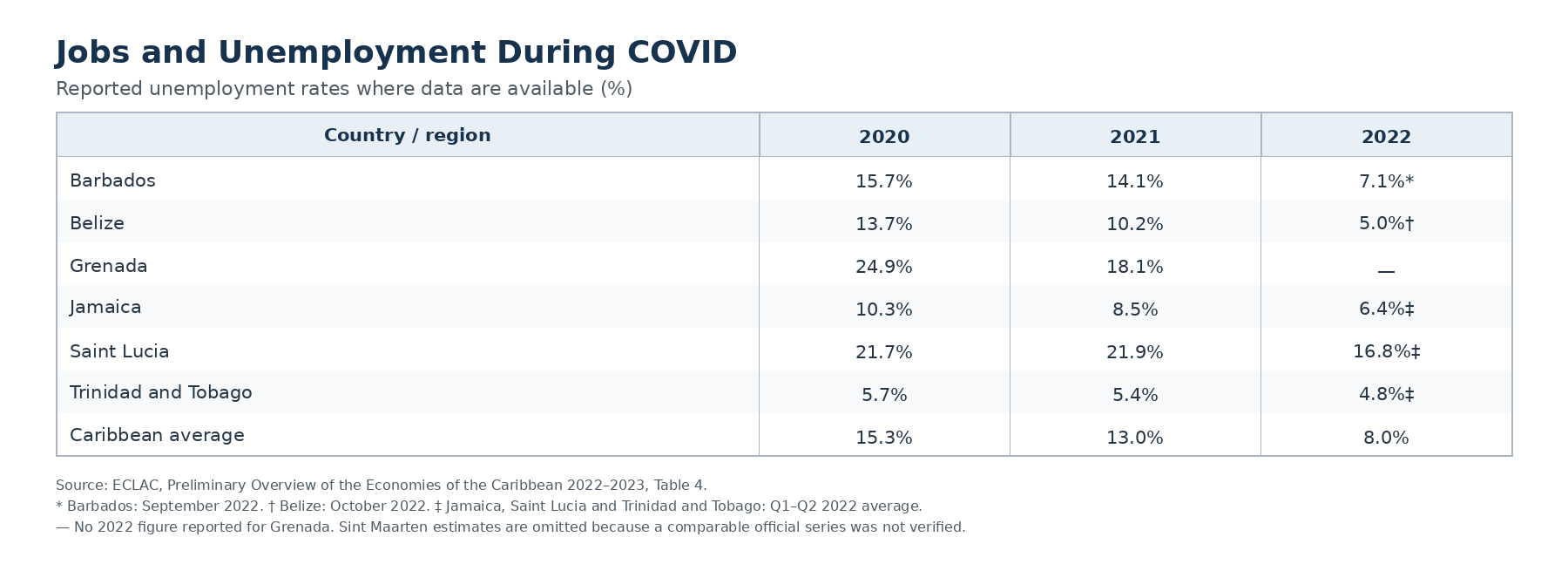
Some workers were laid off. Others had their hours reduced, were placed on unpaid leave or had to accept lower earnings. Self-employed people and informal workers were especially vulnerable because many did not have access to the same employment protections or benefits as workers in formal jobs.
The International Labour Organization estimated that 9.9% of working hours across the Caribbean would be lost in the second quarter of 2020 compared with the final quarter of 2019—the equivalent of approximately 1.5 million full-time jobs. This was an estimate of lost working time across the countries included in its analysis, not a count of 1.5 million individuals permanently dismissed.
That distinction matters. A person whose hours disappeared may technically have remained employed, but if their earnings fell, the financial and emotional consequences could still be severe.
Read the ILO’s Caribbean assessment of COVID-19 employment losses.
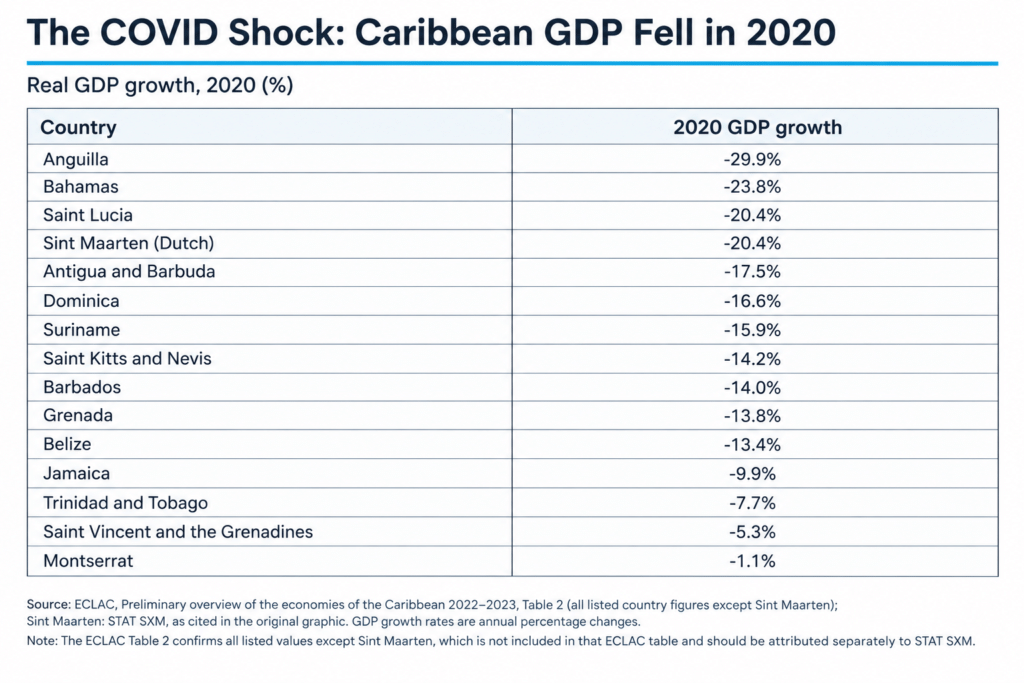
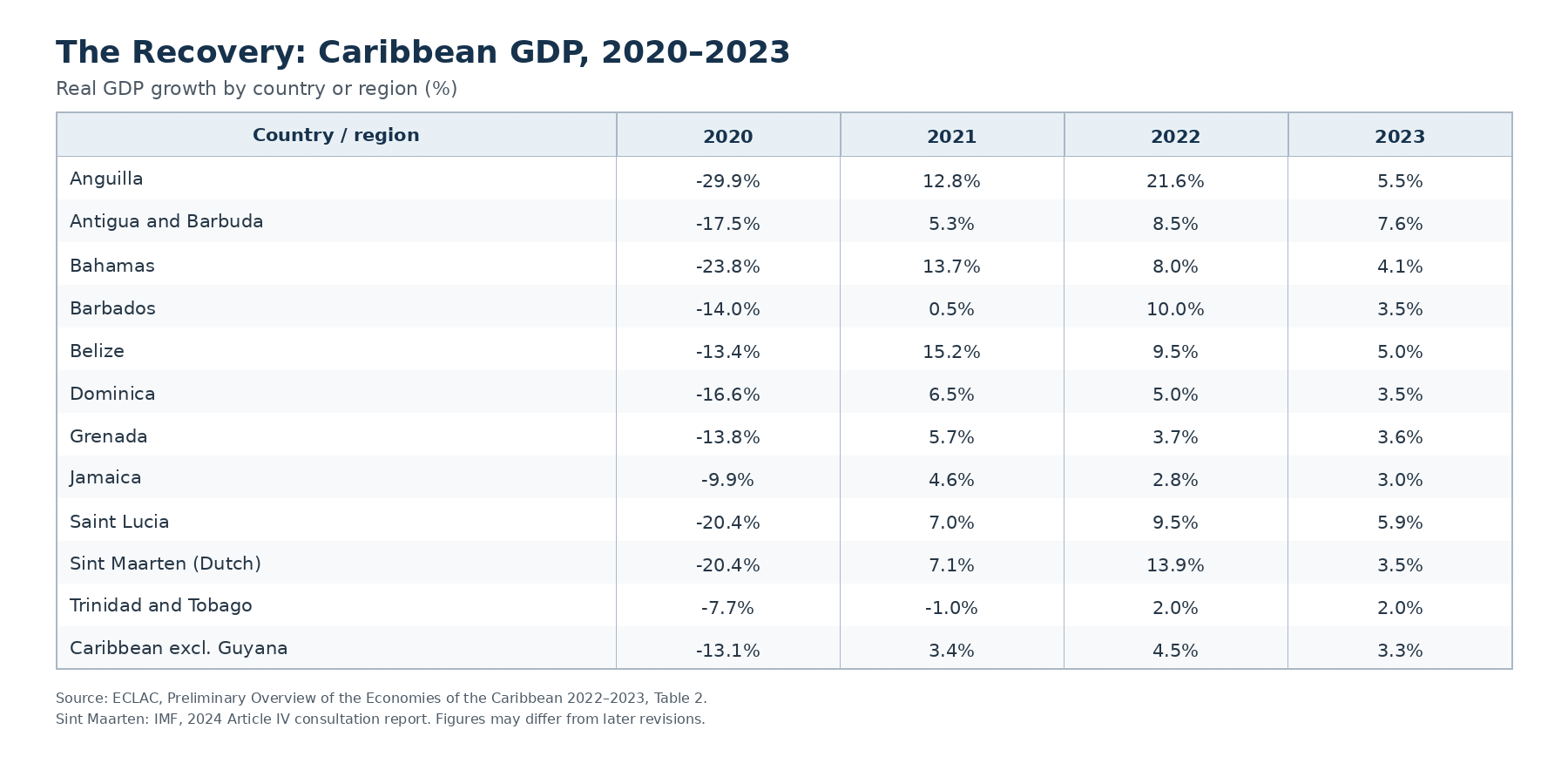
The World Bank reported that some Eastern Caribbean economies experienced GDP contractions of 16–20% in 2020. In the Organisation of Eastern Caribbean States countries covered by its analysis, tourism represented an average of 35% of GDP and provided more than half of all jobs. With international travel almost completely halted, the economic shock was profound.
Read the World Bank’s assessment of the pandemic’s impact on Eastern Caribbean countries.
These numbers describe economic damage, but behind them were people trying to keep their households together.
What happens to a person’s peace of mind when the work they depend on disappears—and there is no clear date when it will return?


Why the impact could feel different in smaller economies
The pandemic caused hardship in wealthy countries as well as developing ones. Workers in major economies lost jobs, businesses closed, and families faced bereavement, isolation and financial stress. It would be wrong to suggest that people in larger countries simply moved into other jobs or escaped the crisis.
However, economies with a wider range of industries had more possible routes to employment when one sector was severely disrupted. Depending on local conditions, those alternatives included manufacturing, technology, healthcare, financial services, logistics, construction or public administration.
In a small island economy heavily dependent on tourism, the alternatives were more limited. A hotel receptionist cannot automatically become a software developer. A taxi operator cannot instantly replace lost tourist fares with another reliable source of income. A tour guide cannot necessarily transfer their skills into a different industry without retraining, investment or available vacancies.
Geography and scale matter, too. Smaller domestic markets can limit the number of customers available to support businesses when international travel stops. A business that relies on cruise passengers, airline arrivals or hotel guests may have few immediate alternatives when those customers disappear.
The World Bank’s more recent analysis of Caribbean tourism has continued to highlight the sector’s importance to regional jobs and the vulnerability exposed by the pandemic. The International Labour Organization has also called attention to the need for economic diversification and better-quality employment.
This is not an argument against tourism. Tourism provides livelihoods, supports entrepreneurs, creates opportunities for young people and shares Caribbean culture with the world. The question is whether Caribbean economies can strengthen tourism while also developing other sectors, so that a future crisis does not place so many households at risk at the same time.
Read the ILO’s 2025 analysis of economic diversification and job creation in the Caribbean.
When income disappears, the stress does not stay at work
Financial hardship is not only a matter of money. It can affect identity, relationships, confidence and a person’s sense of control over their future.
Imagine a parent who worked for years to provide stability for a family, during the pandemic, lost his or her job. She continued to smile for her children, reassured relatives and told friends that everything would work out. Yet privately, she calculated how many days remained before the bills were due with tears in her eyes.
Imagine a young adult who had just started earning, saving or planning to move out, only to find that the opportunities they expected disappeared.
Imagine a small business owner who used personal savings to keep a company afloat, hoped that the next season would bring customers back. When business eventually resumed, the owner was still repaying debts and trying to recover what was lost.
These are illustrative examples that show how economic shocks can become emotional burdens.
Financial stress can contribute to anxiety, low mood, irritability, sleep difficulties and tension at home. Not everyone who experiences these difficulties develops a mental health condition, and financial hardship is not the only cause of mental illness. Nevertheless, prolonged insecurity can make it harder for people to feel safe, hopeful or in control.
The return of tourists or the reopening of a workplace does not automatically restore lost savings, repair strained relationships or remove the fear of another shutdown.
Some people may feel grateful to be working again but exhausted by the pressure to catch up. Others may have found new jobs but earn less than before. Some businesses survived, while others never reopened.
For many, recovery has been a process rather than a single moment.
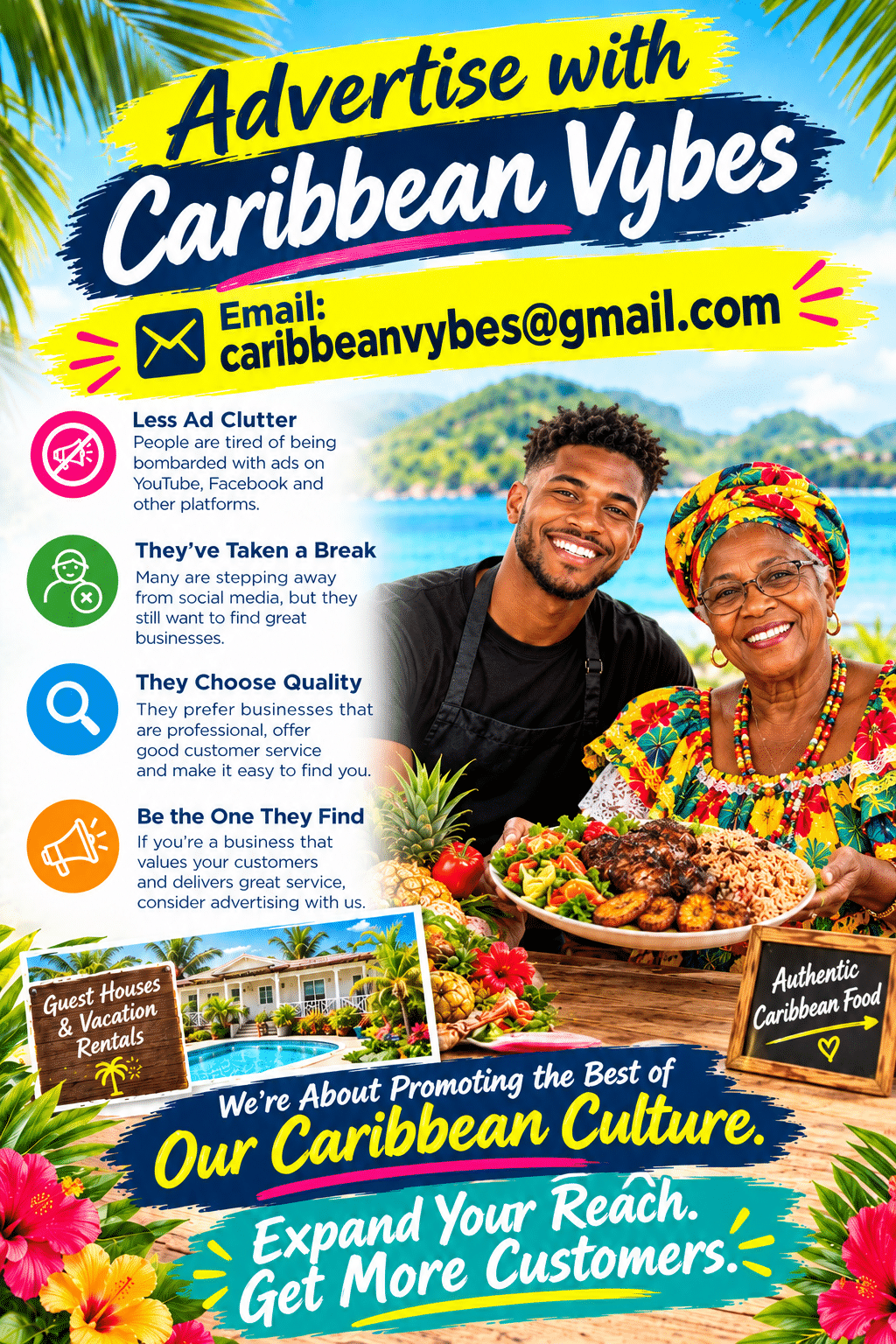

If you’re on the island of St. Maarten, visit UNCLE BOB’S PLACE. Their food is ALWAYS cooked with love.
So, what does healing look like now?
Healing will not look the same for everyone.
For one person, it may mean seeking professional help after years of trying to manage alone. For another, it may mean rebuilding a business, finding more secure employment or learning to live with the loss of someone they loved.
For a family, it may mean talking more openly about stress rather than hiding it. For a workplace, it may mean recognising that employees have lives and responsibilities beyond their jobs. For a government, it may mean ensuring that mental health services are accessible, properly supported and shaped by the people who use them.
For the Caribbean, healing must also include building resilience beyond the next tourist season. That means strengthening social protection, supporting small businesses, improving access to training, developing more diverse economic opportunities and making mental health care part of ordinary community life.
And for the rest of the world, it means remembering that economic recovery and human recovery are connected, but they are not identical.
If you are still struggling, you do not have to prove that your experience was difficult enough to deserve support. Consider speaking with someone you trust or contacting a qualified health professional. If distress is persistent, is affecting your daily life or feels unmanageable, professional help can be an important step. If you or someone else is in immediate danger, contact local emergency services.
We should also check in with the people around us. Rather than asking only, “Are you okay?”, we can make time to listen to the answer. We can avoid rushing to offer solutions, dismissing someone’s concerns or comparing their difficulties with our own.
Sometimes the most helpful response is to say: I’m listening. You don’t have to pretend with me.
A question the world must continue to ask
COVID-19 reminded us how connected our lives are. A health emergency in one part of the world could disrupt employment, education, travel, family life and mental well-being almost everywhere.
It also revealed how differently people experience a shared crisis. Some had savings and secure jobs; others lived from one day’s earnings to the next. Some had space and support at home; others faced isolation, overcrowding or difficult family circumstances. Some could work remotely; others depended on customers physically showing up.
These differences matter when we talk about recovery.
The pandemic may now feel like a chapter that has closed, but for people still dealing with grief, financial strain or emotional difficulties, its effects may remain part of everyday life. Their experiences deserve to be heard without judgement and taken seriously without assuming that everyone has been affected in the same way.
Let us move beyond asking whether we survived. Let us ask whether people have the support, dignity, opportunities and care they need to live well.
Let us listen to workers who lost their earnings, families who endured uncertainty, young people whose lives were disrupted and those who carried their struggles quietly. Let us hear their stories—and then make changes that reflect what we have learned.
We survived the pandemic. But did we ever really heal?
Perhaps the more important question is whether we are willing to make healing a shared responsibility, rather than expecting each person to manage alone.
Because surviving a crisis is only the beginning. Building a world where people feel heard, supported and able to recover is work that must continue long after the emergency ends.
We survived the pandemic. Now, let us make sure that surviving is not all we ask of one another.
Sources
- World Health Organization — World Mental Health Day 2026
- World Health Organization — Global anxiety and depression increased during the first year of COVID-19
- United Nations — Secretary-General’s message on mental health and COVID-19
- International Labour Organization — Caribbean working-hour losses during COVID-19
- World Bank — COVID-19’s socioeconomic impact on Eastern Caribbean countries
- St. Kitts and Nevis Information Service — COVID-19 Emergency Relief Fund applications
- International Labour Organization — Economic diversification and job creation in the Caribbean